Keep the load contained and controlled
Goods must be safely contained in the vehicle body or securely fastened and protected against being dislodged or spilled. They must not drag on the road or obscure the driver’s forward, side or required mirror view. Think about braking and cornering, not only whether the load stays still while parked.
A container designed for twist-lock fastening must be secured with at least four twist locks. For a motorcycle, use suitable securely attached carriers. Recheck the actual load and fastening after loading changes; a cover over loose goods is not necessarily an adequate restraint.
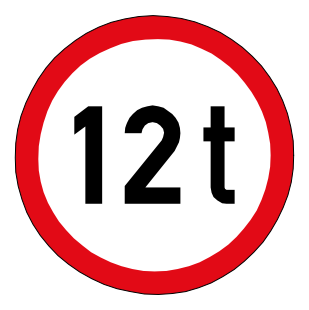
The illustrated mass-limit sign adds a road restriction. Check the relevant vehicle mass before entry; secure fastening alone does not permit a vehicle exceeding that signed limit.
Roof-load height on a motor car
For a motor car, the height of goods above the highest point of the roof may not exceed half the car’s height measured from ground level. The manual excludes pedal cycles from this particular roof-height calculation. All the other requirements - secure fastening, visibility, overall dimensions and safe loading - still apply.
If the car is 1.6 m high, the goods-height allowance under this rule is 0.8 m above the roof. This arithmetic does not establish the roof’s permitted load mass: the rack and vehicle also have their own rated limits.
Light and heavy vehicle projections
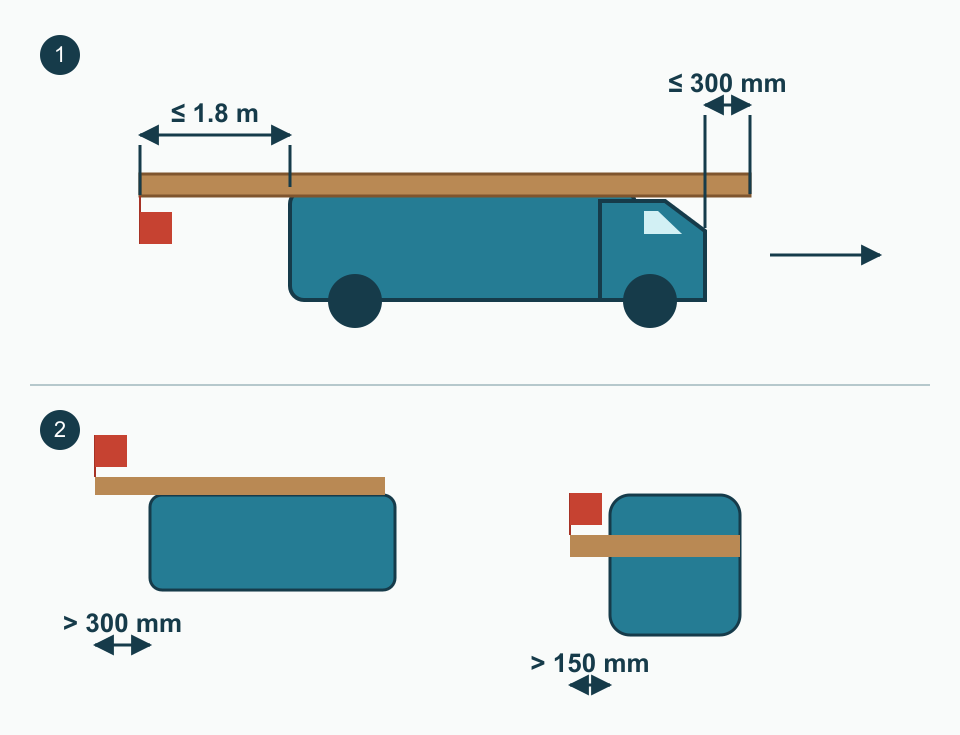
Goods may project no more than 300 mm beyond the front end and 1.8 m beyond the rear end. Side limits are measured from the longitudinal centre line: 1.3 m on each side for a bus whose front-tyre centre lines are more than 1.9 m apart, or a goods vehicle of at least 12,000 kg GVM; 1.25 m on each side for other vehicles. The 2009 regulation links these categories to the overall-width rule and resolves the old manual’s misleading “exceeds 12,000 kg” wording.
The side allowance is not added outside the body. For example, 1.3 m each side permits a total cargo width of 2.6 m, not a body plus another 2.6 m. The specified mirrors and indicators are excluded from this calculation, but cargo is not.
Brackets may not project more than 150 mm beyond the widest vehicle part. The front overhang together with the projection must also comply with its separate limit, and the vehicle/combination plus its projection must not exceed the overall length permitted by regulation 221. A permitted rear projection cannot simply be added to a vehicle already at its maximum overall length.
Warn others about a projecting load
Marking is required when a load projects more than 150 mm beyond a side or more than 300 mm beyond the rear. By day, use red cloth flags at least 300 mm by 300 mm, suspended by adjacent corners across the direction of travel. For side projection, mark its front and rear extents; for rear projection, mark its end.
Between sunset and sunrise, or when people and vehicles cannot clearly be seen at 150 m because of poor light or weather, use the prescribed lights or retro-reflectors. For a side projection, show white at its outer front edge and red at its outer rear edge. For a rear projection, mark its width in red at the end and its length with yellow on both sides at the end. Where the rear projection is less than 600 mm wide, one rear red lamp or reflector is sufficient to mark that width.
These warnings make an otherwise permitted projection visible. They do not legalise excessive projection or an insecure load. Do not use the simpler daytime flag rule as the complete night-time rule.
Panel 1 distinguishes the ordinary maximum front projection of 300 mm and rear projection of 1.8 m from the warning thresholds. Panel 2 shows that a rear projection over 300 mm or side projection over 150 mm requires the prescribed warnings. Its flags illustrate daytime marking only; use the night or poor-visibility arrangement described above when applicable. The diagram is not to scale and does not override total width, overall length, overhang or secure-loading limits.
People are not ordinary cargo
The manual requires the compartment carrying people in a goods vehicle to have sides at least 350 mm above the seating surface for seated people, or 900 mm above the standing surface for standing people. Passengers may not travel in a caravan. These dimensions alone do not authorise a passenger service.
The amended rule prohibits carrying schoolchildren for reward in a goods compartment. It also prohibits carrying other people for reward there, except where the vehicle complies with the National Land Transport Act. The separate transport-law permission cannot be created simply by fitting higher sides.
Worked situation
A plank projects 500 mm behind a bakkie but remains within the permitted rear overhang. It exceeds the 300 mm warning threshold, so it needs the prescribed daytime flag or poor-visibility/night reflector arrangement. The driver must also secure it and keep lamps and the number plate visible.
Check before accepting a load
Check rated mass, dimensions, fastening, driver view, lamps and plates, required projection warnings and whether carrying people is lawful. Satisfying only the overhang rule is not enough to make the journey lawful.