Overall length needs the correct configuration
The manual’s brief length list omits axle-layout distinctions, buses and the exactly-12,000 kg trailer boundary. Regulation 221 supplies the distinctions below. Check whether a drawbar or coupling is included; use the actual configuration rather than the generic word “trailer”.
A trailer with one axle or one axle unit, other than a semi-trailer, is limited to 8 m excluding drawbar/coupling when its GVM does not exceed 12,000 kg, and 11.3 m when it exceeds 12,000 kg. Another non-semi trailer over 12,000 kg is limited to 12.5 m excluding drawbar/coupling. An articulated vehicle or drawing-vehicle/semi-trailer combination is limited to 18.5 m including the connection.
The other stated limits are 22 m for a bus-train, 26 m for the specified rapid-transport bus-train, 15 m for a bus, 12.5 m for other vehicles excluding semi-trailers, and 22 m for other combinations. The last combination limit excepts a breakdown vehicle while towing. A non-swivelling coupled trailer has a separate 1.8 m maximum including its connection.
The regulation excludes qualifying front protection equipment that increases length by no more than 300 mm from the length calculation; the manufacturer’s bumper is not that exclusion. These provisions do not override a lower signed road restriction or permit an overlong load.
The illustrated length-limit sign can prohibit a vehicle shorter than the general maximum. Read its displayed length and compare it with your actual permitted configuration.

Height includes the load
The overall height, including any load, may not exceed 4.65 m for a double-deck bus or 4.3 m for another motor vehicle under the manual’s ordinary rule. Measure to the highest part that will actually travel, including carried goods or equipment.
A vehicle below the general maximum may still be too high for a signed bridge or entrance. Know its actual height before choosing the route. Never use the statutory vehicle maximum as an estimate of the clearance under a structure.

Width depends on vehicle type
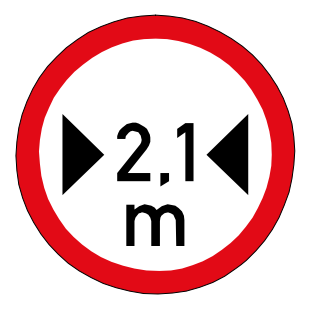
The manual allows an overall width up to 2.6 m for a bus whose front-tyre centre lines are more than 1.9 m apart, and for a goods vehicle with GVM of at least 12,000 kg. The ordinary maximum for other vehicles is 2.5 m.
The tyre-centre distance is a condition for that bus category, not the bus’s width. Apply the definition of overall width and its specified equipment exclusions, then check load-projection rules separately. A permitted mirror projection does not allow cargo to project by the same amount.
Worked situation
A loaded vehicle is 4.1 m high, below the ordinary 4.3 m maximum. A bridge is signed with a 3.9 m height limit. The vehicle may not use that route. General vehicle compliance and the local structure’s restriction must both be satisfied.