Ask four questions of a supplementary plate
First read the main instruction. Then ask: to whom does it apply, when does it apply, where does it apply, and under what condition? A supplementary plate narrows or qualifies the sign with which it is displayed; it is not an independent permission to ignore the main sign.
Time plates include a single period, two periods, specified days and a maximum stay. A maximum-stay plate answers how long you may remain during the stated period. Reduced-visibility, daytime and night-time plates answer when the accompanying instruction applies. Read the exact times and symbols on the installed sign.
A vehicle-class symbol limits the command or prohibition to that class. Operator logos or names identify the authorised operator. A pay-and-display plate requires the stated payment/display procedure. A maximum-number plate limits the number of vehicles using the reserved area; it is not a speed limit.
- Directional reservation signs show reserved movements left, right or both directions for the indicated class. Read both the directional arrow and the vehicle symbol.
- If a no-parking sign applies to motorcycles during a stated period, it does not become a motorcycles-only parking sign. The prohibition remains the main instruction.
- Do not guess a missing or unreadable condition from the sign code in a book. Slow early enough to read the actual plate safely.
Combine the conditions without reversing the instruction
The manual illustrates limit-plus-limit, action-plus-limit, action-plus-object and object-plus-limit arrangements. The reading order remains the same: establish the main sign, then apply every relevant condition. Two plates do not cancel one another.
For example, a headlamp command qualified by reduced visibility requires headlamps in that condition. A construction-vehicle reservation with operating hours reserves the area for that class during those hours. A motorcycle plate under a no-parking sign applies the prohibition to motorcycles. A speed-limit sign with a vehicle plate restricts the indicated class rather than reserving the road for it.
A sign allowing only vehicles over a displayed mass answers which vehicles may use the road. The same mass shown on a prohibitory mass-limit sign answers which vehicles may not enter. Reading only the numeral produces the opposite answer.
- The learner manual contains caption errors in its combinations table, including a headlamp command mislabelled as a toll command and a construction-vehicle speed-limit example described as a mass-only instruction. Follow the displayed sign meaning and the primary regulatory definitions; do not memorise those erroneous captions.

What ends, and what continues?
De-restriction signs cancel the particular regulation illustrated. Identify the symbol crossed out or otherwise cancelled and relate it to the restriction you were following. Do not treat a cancellation panel as permission to drive without any rules.
After a temporary roadworks restriction ends, other permanent limits and general road rules still apply. After a lane reservation ends, its cancellation does not authorise unsafe lane changes. Reassess the next signs, lane markings, traffic and visibility before increasing speed or changing position.

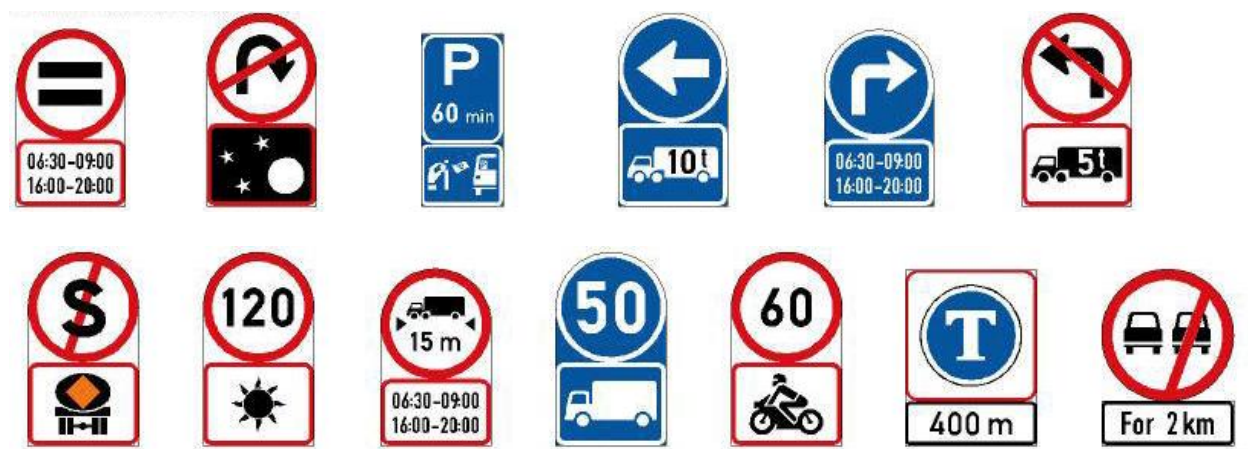
Thirteen regulatory combinations on page 22
Apply the main sign first, then read every displayed plate. Work through the examples below without treating a class symbol as an instruction on its own.
- No unauthorised vehicles during the two stated periods: authorisation and time both qualify entry.
- No U-turn at night: the night-time plate qualifies the prohibited manoeuvre.
- Limited parking with pay-and-display: observe the maximum stay and the payment/display condition.
- Proceed left only for goods vehicles above the indicated GVM: both the movement and the class threshold matter.
- Turn right during either stated period: read both time windows.
- No left turn ahead for goods vehicles above the indicated GVM: prepare a lawful alternative before the junction.
- No stopping for vehicles carrying dangerous goods: do not treat it as a parking-only restriction.
- A speed limit qualified for daytime: the sun symbol is a time condition.
- A length limit during either specified period: the number measures vehicle length, not speed.
- A minimum speed applying to goods vehicles: distinguish the blue command from a red-ring maximum.
- A maximum speed applying to motorcycles: the vehicle plate limits the instruction to that class.
- Toll payment 400 m ahead: the distance tells you where the toll point is approaching, not the length of a toll charge.
- No overtaking for 2 km: the “For” plate states the extent of the restriction.
Seven continued combinations on page 23
These examples add enforcement information and combine a warning with a restriction. The displayed times belong to the example; on the road, read the actual installed values.
- Delivery vehicles only from 06:00 to 09:00: the circular class command applies during that period.
- Vehicles carrying dangerous goods only during 07:00–09:00 and 16:00–18:00: read both windows.
- An 80 km/h maximum with a camera plate: the limit is enforceable; the camera symbol does not change its value.
- A 60 km/h maximum from 06:00 to 09:00: read the time on the displayed plate. The printed caption code conflicts with the time plate and should not be memorised as its identifier.
- A 100 km/h maximum at night: the moon/star plate is the time qualifier.
- A 60 km/h maximum with winding road for 8 km and flashing lamps: combine the regulation, hazard and affected length.
- Motor cars prohibited from 06:00 to 09:00: this is a prohibition on that class, not a reserved-car route.

Every limit/action/object example on page 38
The four headings are a reading aid, not four new sign families. Several examples repeat the same semantic combination. The list below retains each distinct instruction, including the corrected code-caption cases, so that the table is covered without teaching a printed mistake.
- Limited parking plus pay-and-display: satisfy both the time allowance and the payment procedure.
- Mass limit plus time period: the mass restriction applies during the stated period.
- Speed limit plus mass qualifier: establish the mass category to which the speed applies.
- Temporary limited parking plus stated periods/days: check the temporary times and maximum stay.
- Minimum speed for trucks/goods vehicles: the class qualifies the command.
- Maximum speed during daytime: read the sun qualifier.
- Maximum speed at night: read the moon/star qualifier.
- Temporary maximum speed in reduced visibility: the condition qualifies the limit.
- Temporary maximum speed for construction vehicles: the repeated illustration is a speed/class combination, despite one erroneous mass-only caption.
- Limited parking for minibuses: both the reserved class and parking limit apply.
- No right turn ahead during the stated periods: do not wait until the prohibited turning point to choose an alternative.
- No stopping during the stated period: the time plate does not turn it into no-parking only.
- Proceed straight only for goods vehicles above the indicated GVM: follow the arrow if your vehicle meets that class/threshold.
- Parking reservation during the stated period: use the actual times to determine when the reservation operates.
- Bus-lane reservation during the stated period: ordinary traffic must stay out while it applies.
- Keep left for motorcycles: the side-of-obstruction instruction is limited to that class.
- Turn left for delivery vehicles: the delivery-vehicle symbol qualifies the turn command.
- Switch headlamps on in reduced visibility: follow the headlamp command; the printed caption incorrectly identifies it as a toll command.
- Overtaking prohibition qualified by the dangerous-goods vehicle class: read the class together with the overtaking symbol.
- No right turn ahead for buses: it remains a prohibition, not a bus-only right turn.
- Tour buses only during the stated periods: the time qualifies the class-only command.
- Taxis prohibited during the stated period: the time qualifies the prohibition.
- Pedestrians prohibited during the stated period in the temporary arrangement.
- High-occupancy vehicle parking reservation during the stated period: check the occupancy condition and the time.
- Construction-vehicle reservation during the stated period: check class and time before entering.