Use the left side and carriageway
The general principle is to keep left and normally overtake to the right. The following lesson, “Overtaking and being overtaken”, explains the conditions and exceptions.
Drive on the left side of a two-way roadway without obstructing or endangering approaching traffic. On a divided public road, use the left-hand carriageway unless a traffic sign or traffic officer directs or permits another course. The empty carriageway on the other side of the divider is not an overtaking lane for your direction.
If an obstruction requires you to move towards or across the centre, first establish that there is enough clear road and that approaching traffic will not be endangered or obstructed. A gap that forces an oncoming driver to brake is not a safe gap. Obey prohibitory markings and do not use a general “keep left” rule to disregard an authorised direction.
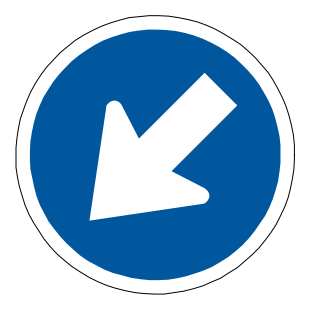

A signal is a request, not priority
Before changing lanes, check traffic ahead, beside and behind. Use mirrors and the appropriate observation for the vehicle’s blind areas, signal in good time, then move only when the lane is clear and the movement will not obstruct or endanger another road user. Keep checking while changing position; another vehicle may enter the same gap.
Do not drift across a lane line because your route is about to turn. If the safe opportunity has passed, continue to a lawful alternative. A large vehicle needs more space and may hide a motorcycle alongside it; allow for the full vehicle and load, not just the cab.
The limited daytime shoulder exception
A shoulder is not an extra traffic lane. The manual allows the driver of a light motor vehicle to move onto the left shoulder to let another vehicle pass only under all the specified conditions. This permission does not authorise a following driver to overtake on the shoulder.
Check the shoulder itself for pedestrians, cyclists, stopped vehicles, debris and a dropping edge. If any condition fails, stay in the roadway and allow the other driver to wait. Courtesy must remain lawful and safe.
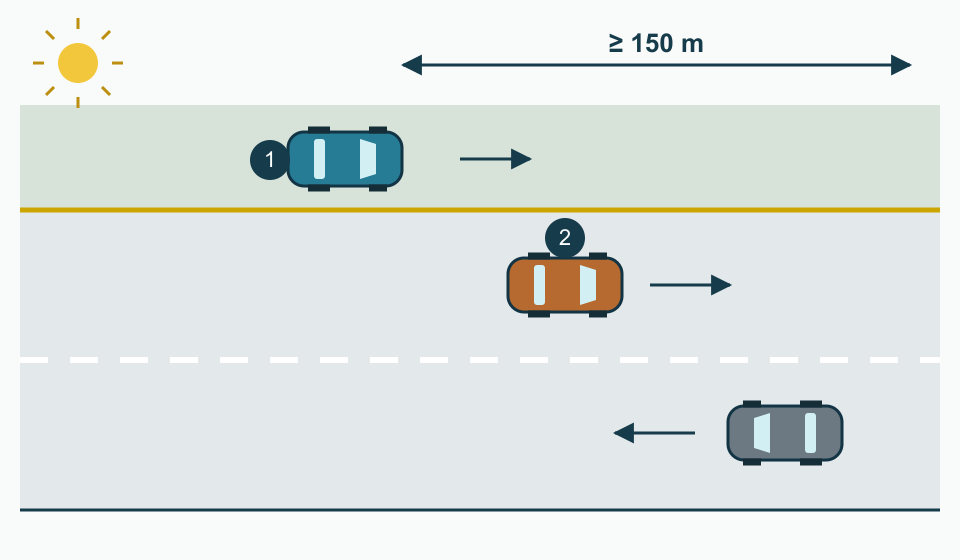
In the diagram, 1 is the light vehicle moving onto the left shoulder to allow vehicle 2 to pass. There is one lane in each direction and it is daylight. People and vehicles on the road must be clearly visible at a distance of at least 150 m. All the other safety conditions must also be satisfied; the picture alone does not authorise shoulder use. It is not to scale.
- It must be between sunrise and sunset.
- The road must have one traffic lane in each direction.
- Your vehicle must be being overtaken by another vehicle.
- You must be able to do so without endangering yourself, other traffic, pedestrians or property.
- People and vehicles on the road must be clearly visible at a distance of at least 150 m.
Make a lawful pass easier
When being overtaken, keep as far left as is safe and do not accelerate. You do not have to enter an unsafe shoulder. Near a stationary bus, expect pedestrians to step out where they cannot see approaching vehicles; reduce risk before reaching its concealed front or rear.
Worked situation
It is dusk on a road with one lane each way. A truck follows closely and flashes its headlights. The light-vehicle shoulder concession requires daylight and all the other conditions, so pressure from behind does not make shoulder driving lawful. Maintain a safe position and speed, then use a lawful stopping place if you need to let traffic pass.
Position checklist
Choose the lawful side, check the full movement, signal before changing position and maintain safe clearance. Use a shoulder only within its specific exception; never treat it as a general passing lane.