Make the forced stop safer
If a defect forces you to stop, use any remaining control to reach a position away from moving traffic without making an unsafe sudden movement. A breakdown is not planned parking, but it still requires you to reduce the danger to approaching traffic. Secure the vehicle against movement and decide whether anyone is exposed to a live lane.
Warn other road users with the available lawful warning equipment and obtain help. Do not stand behind a vehicle in a live lane or move into fast traffic merely to inspect damage. A triangle is a warning to approaching traffic, not a barrier that physically protects you.
Carry the triangle required for the vehicle
The 2012 manual’s blanket exclusion of motor cars is incomplete. Regulation 214 names the exclusion as “an ambulance or motor-car first registered before 1 July 2006”, and also excludes motorcycles, motor tricycles and motor quadrucycles. An ordinary motor car first registered on or after 1 July 2006 is within the triangle rule. Keep an approved warning triangle with an applicable vehicle. The special ambulance wording must be read in its full regulatory context; do not infer an exemption for an ordinary modern car from it.
For a vehicle combination, the triangles required for the vehicles may be carried on the drawing vehicle. Use a triangle of the prescribed design and certification for the class; a homemade warning shape is not a substitute.
Place it where approaching traffic can see it
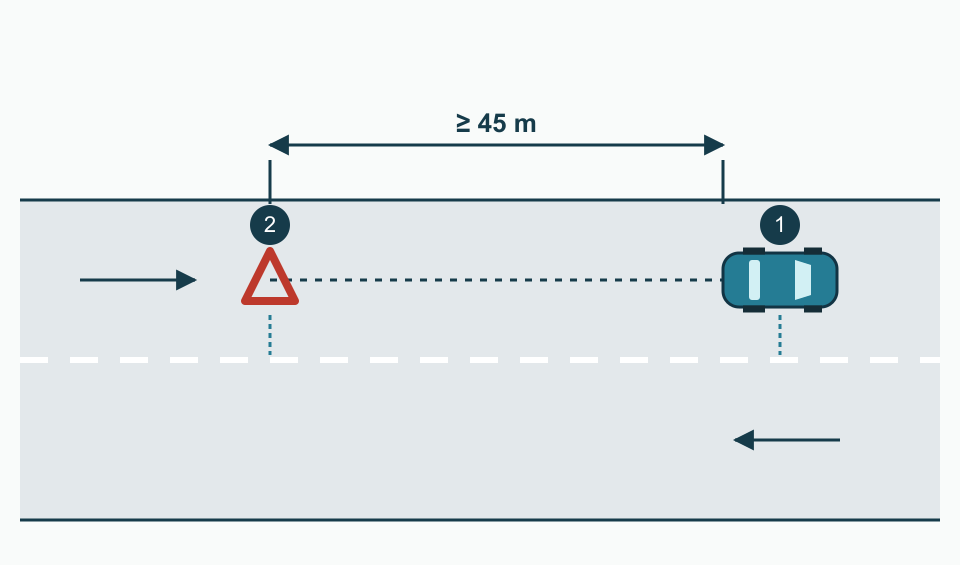
Where the display rule applies, put at least one triangle no less than 45 m from the stationary vehicle in the direction from which traffic approaches on that side of the road. Its reflective face must point towards approaching traffic. Position it laterally about the same distance from the roadway edge as the transverse centre of the vehicle.
The distance is measured towards the approaching traffic, usually behind the vehicle in its direction of travel. “45 m behind” without considering the traffic direction can give the wrong result on a differently positioned vehicle. Avoid creating another danger while placing the warning.
In the diagram, 1 is the stopped vehicle and 2 is the warning triangle. The triangle is at least 45 m towards approaching traffic, aligned laterally with the vehicle’s centre. Its reflective face must face that approaching traffic. The drawing is not to scale and does not show the reflective face’s tilt.
When the stationary-vehicle display exception applies
The amended rule covers an applicable vehicle stationary on the roadway or shoulder. It excludes the following specified stops; an exception to display does not remove a separate duty to carry the required equipment.
- Where a sign authorises loading or unloading.
- Where the stop obeys a road traffic sign or a traffic officer’s direction.
- Where other traffic causes the stop and the driver remains in the driving seat.
- In the stated circumstances accompanying a State or municipal function.
Do not leave a vehicle indefinitely
The manual treats a vehicle left in the same place on a public road outside an urban area for more than 24 hours as abandoned, and uses more than seven days in an urban area. These periods do not permit dangerous or prohibited parking in the meantime.
Arrange recovery promptly when a vehicle cannot be driven. Leaving a note or switching on hazard lamps does not make a dangerous position safe or extend the abandonment threshold.
Worked situation
A post-2006 car has broken down on the left shoulder. Traffic approaches from behind. The triangle requirement is not removed merely because it is a car or because it is on the shoulder: use the applicable warning at least 45 m towards that traffic, reflective face towards it, while avoiding personal exposure to moving vehicles.
Use the approved triangle for the class
A goods vehicle, minibus or bus of at most 3,500 kg GVM first registered before 1 July 2007 may use the prescribed double-sided red warning design or the approved standard triangle. Other applicable vehicles need a certified triangle meeting the specified SABS 1329 Part 1 or UN ECE Regulation 27 standard. Do not remove or tamper with a lawfully displayed warning.