Distance to the feature versus length of the section
Countdown boards lead toward an exit or junction: three bars, then two, then one as the decision point approaches. Their sequence is advance notice, not a command to change lanes immediately. The colour relates to the route or temporary context; the bars still tell you that the feature is approaching.
Supplementary information plates can give a recommended speed, the length of a hazardous section, the distance to a feature, explanatory words or a vehicle class. Read “For …” as the extent of the affected road and a plain distance-to-feature as advance notice. Do not exchange the two meanings.
If a warning says a hazard is 400 m ahead, prepare before reaching it. If it says the hazard extends for 3 km, continue adapting through that section rather than accelerating 3 km before it begins.
What the information panel adds
Cul-de-sac signs identify a road that does not provide a through route; the diagram can show whether a side road or the road ahead ends. Right-of-way information identifies priority relative to the opposing approach at the restricted section, but still requires care for anyone already occupying it.
Park-and-ride boards identify places to leave a vehicle and transfer to public transport. Modal-transfer panels show the available connection between modes. Information-centre signs direct you to travel information; they are not police or compulsory stopping instructions.
A road-experiment board warns of an unusual or trial arrangement, so study the actual markings and controls. Coordinated-signal information explains the intended sequence along a route; it does not authorise speeding to catch a green. Multi-phase-signal information warns that movements receive different phases, so follow the signal facing your lane rather than copying adjacent traffic.
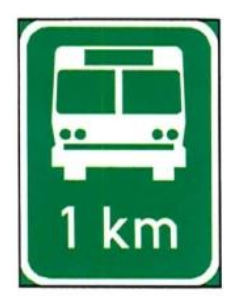
The bus-stop/pickup-ahead panel alerts you to the facility ahead. Expect buses or minibuses to slow, stop or rejoin, and keep clear of any separately reserved stopping area. The official colour example appears in the next section.
Bus stop ahead: the official engineering drawing
The official bus-stop-ahead sign shows a white bus symbol and distance on a green background, with a white border. The full-colour example is copied from the official sign-design manual.
The sign announces a bus stop or pickup point ahead at the distance shown. It is especially useful where a stop has moved or people would otherwise gather at an unsafe location. It is information about the facility ahead, not a bus-lane command or permission to stop immediately beside the board.
Expect buses and passengers near the announced point, reduce speed as conditions require and obey any separate stopping or reservation restrictions. The lack of an arrow distinguishes the ahead-distance notice from a turn-direction sign.