Places where parking is prohibited
Before leaving a vehicle stationary, check both signs and the general rules. An absence of painted lines does not make every space legal. Parking is prohibited wherever stopping is prohibited, and wherever a sign prohibits it. Follow a traffic officer’s lawful direction; a forced stop beyond the driver’s control is different from choosing a parking place.
- Do not park within 1.5 m on either side of a fire hydrant on the same side of the road.
- Do not hide a road traffic sign.
- Do not project onto the sidewalk or obstruct a public or private vehicle entrance.
- Do not park in a position that makes another road user unable to see or pass safely.

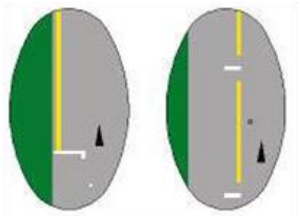
Outside an urban area
Do not park on the roadway of a public road outside an urban area. No part of the parked vehicle may be within 1 m of the roadway edge. The shoulder is outside the roadway, but it may still be too narrow to achieve that clearance. Measure to the nearest part of the whole vehicle, not merely the outer tyre.
If no lawful and safe position exists, continue to a suitable stopping or parking place. Hazard lights do not cancel the distance requirement or authorise leaving a vehicle in a live lane.
Within an urban area
Urban parking has additional distance and positioning restrictions. Check the direction of approach to a crossing before measuring its protected area.
Read the four diagram panels separately. Panel 1 shows the 9 m no-parking area on the approach to a pedestrian crossing; panel 2 shows the 5 m intersection clearance; panel 3 shows 1.5 m on each side of a hydrant; panel 4 shows the whole vehicle at least 1 m clear of the roadway edge outside an urban area. The red area marks the crossing approach restriction, not permission to park elsewhere. Other prohibitions still apply. The panels are not to scale.
- Do not park within 9 m on the approach side of a pedestrian crossing.
- Do not park within 5 m of an intersection.
- Do not park on or over the actuating mechanism of a traffic signal.
- Park close to the left edge: the outside of a left wheel must not be more than 450 mm into the roadway from the edge, unless the applicable arrangement lawfully directs otherwise.
- Do not park on a roadway narrower than 5.5 m.
- Do not park on a traffic island, pedestrian mall or pedestrian lane.

Worked situation
A kerb space is 2 m long and has a fire hydrant at its centre. A small car might physically fit, but the prohibited area extends 1.5 m on either side of the hydrant. Do not use that space. Physical fit and lawful clearance are different tests.
Before walking away
Check signs, location, clearances and obstruction; secure the vehicle so it cannot move and switch off the engine before leaving it unattended. Recheck people and traffic before opening a door or later moving away.