Steering must work safely
The steering mechanism must be in good working order so that the vehicle can be controlled safely. Do not continue driving with a defect that prevents accurate directional control. Check that luggage, clothing or accessories cannot foul the steering or control cables.
A compliant steering system must still be used with enough road space. Check the complete turn and the path of the rear of a long vehicle; a vehicle-design limit is not permission to swing into opposing traffic or pedestrian space.
Motorcycle handlebar dimensions
The handlebar arrangement must allow proper control, and the manual gives these dimensions:
- For an engine of 200 cc or more, overall handlebar width must be at least 600 mm and no more than 800 mm.
- For an engine below 200 cc, width must be at least 500 mm and no more than 800 mm.
- Handgrips must not be below the saddle and must not be more than 500 mm above the saddle.
Two independent motorcycle brakes
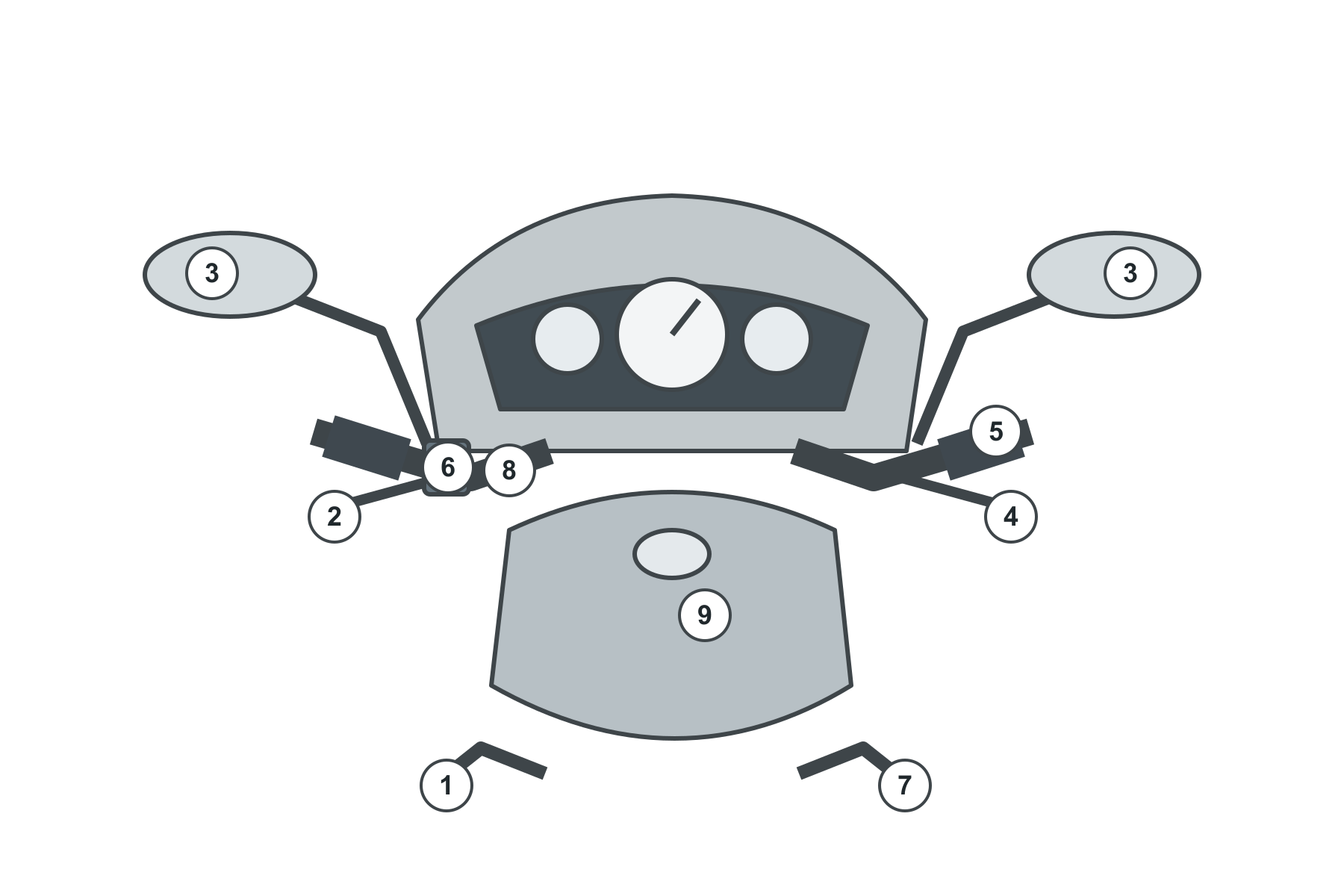
A motorcycle requires two independent braking systems in good working order, one acting on the front wheel and one on the rear. Recognise which control operates each system on the motorcycle you use. A model with a different control layout must still be understood before riding.
Do not assume one working brake makes a failed second system acceptable. The rules specify both functions; the controls lesson teaches their identification and coordinated use.
Service, parking and emergency braking
A light or heavy vehicle requires a service brake, a parking brake and an emergency brake in good working order. The service brake controls speed and stops the vehicle in normal use. The parking brake secures a stationary vehicle. The emergency and parking functions may be provided by the same brake where the prescribed arrangement allows it.
“May be the same brake” does not mean the emergency function is optional or that every vehicle uses an identical mechanism. Learn the fitted controls and do not improvise a brake-system repair or use a defective vehicle.


Worked situation
A motorcycle’s rear brake does not work, although the front brake can stop it in the yard. The prescribed two independent systems are not both serviceable. Repair the defect before public-road use; a short journey is not an exception.
Turning radius and heavy exceptions
The ordinary maximum turning radius is 13.1 m. The inspected regulation gives 17.5 m for a bus-train and a twin-steer four-axle rigid goods vehicle. Vehicle compliance does not make a turn safe: check the whole swept path and other road users before manoeuvring.