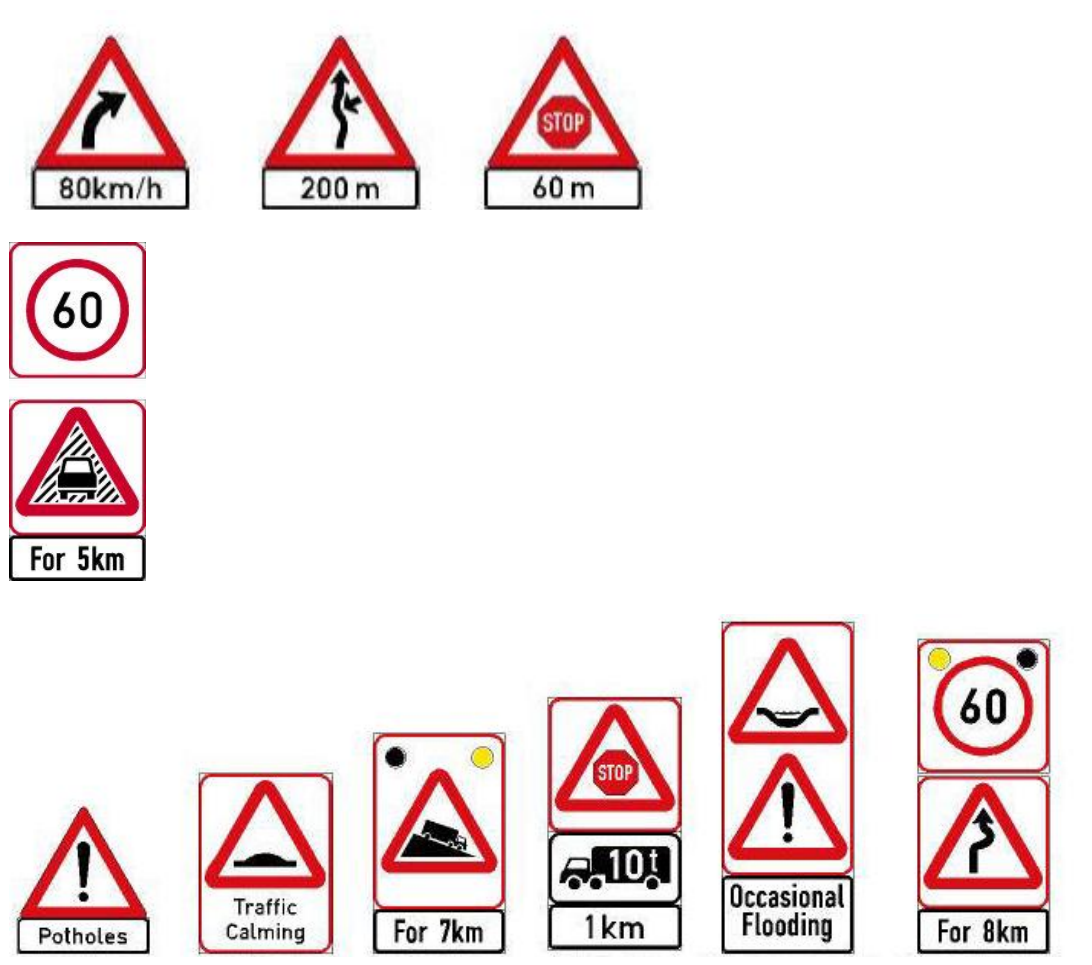
Read every element of the permanent examples
A warning can be combined with an advisory-speed plate, a distance, a length of affected road, explanatory words or a regulatory sign. A flashing lamp or bright backing improves conspicuity; it does not change which symbol is a warning and which is a legal restriction.
“200 m” below a concealed-driveway warning tells you how far ahead to expect the driveway. “For 5 km” under a reduced-visibility combination tells you the length of the affected section. A recommended speed at a bend is an advisory value; a red-ring speed-limit sign in a combined panel remains a maximum limit.
- A gentle right curve with recommended speed 80 km/h. Adjust before the curve and reduce further if conditions require.
- A concealed driveway on the right 200 m ahead. Start checking the right-hand access before reaching it.
- STOP control 60 m ahead. Prepare to stop at the actual stop line or sign.
- A 60 km/h limit combined with reduced visibility over 5 km. Maintain the restriction through the stated affected section and reduce further if you cannot see enough clear road.
- General warning explained by “Potholes”. Avoid sudden swerves into opposing traffic; slow early.
- Expect a speed hump or calming feature, not an uninterrupted high-speed route.
- Flashing lamps highlight a steep descent extending for 7 km. Select a suitable gear before the descent.
- A plate for goods vehicles over 10 t and a 1 km distance qualify the advance STOP warning for the indicated goods vehicles. Read the vehicle class and distance together.
- A drift and flooding risk. Do not assume the crossing is passable simply because a warning sign exists.
- Flashing lamps highlight a 60 km/h maximum with winding road for 8 km. Anticipate successive bends, not just the first curve.
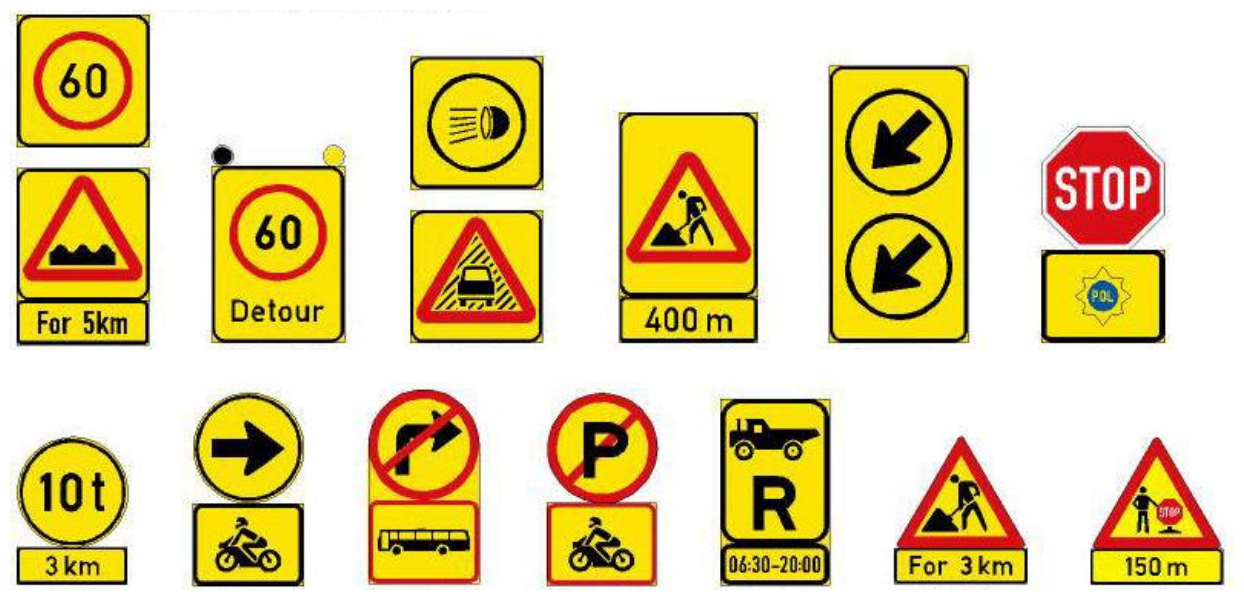
Work through the temporary examples
Temporary combinations may carry a mandatory instruction as well as a warning. Yellow backgrounds signal temporary application; they do not make obedience optional. Look for the route through the works and for a controller beyond the advance warning.
- A 60 km/h maximum and uneven road over 5 km, highlighted by lamps.
- The displayed 60 km/h maximum applies on the diverted route as indicated.
- Switch headlamps on in the reduced-visibility section.
- Roadworks begin 400 m ahead; prepare before entering them.
- The keep-left command on a conspicuous backing directs you to the left of the obstruction. The backing is not a second direction instruction.
- A STOP sign with a police badge requires you to stop for the police control. The badge identifies the operation; it does not weaken STOP.
- The indicated route is for vehicles above the specified mass, beginning 3 km ahead. Do not confuse this advance minimum-mass command with a maximum-mass limit.
- The proceed-right command applies to motorcycles.
- Buses may not turn right ahead.
- Motorcycles may not park in the indicated area.
- The construction-vehicle reservation applies during 06:30–20:00, as shown on its time plate.
- Roadworks extend for 3 km; the number is a length, not distance to their start.
- STOP/GO control is 150 m ahead. Expect a queue before reaching the controller.